
1912 Capital - Fund II
1912 Fund II - Immediate Cash Distributions
Investment Type:
Private Credit
Current Markets:
Alabama, Kansas, Missouri, Ohio, Oklahoma, Arkansas
Expanding New Markets:
Northwest Arkansas, Tennessee, Indiana
Immediate Monthly Distributions:
Class A: 10% - $50,000
Class B: 11% - $500,000
Class C: 12%- $1,000,000+
Minimum Investment:
$50,000
Investment Terms:
2 Years
Documents:
Rule 506(C)
PPM
Operating Agreement
1912 Capital - Fund II Details
Fund I has deployed over $20 million to experienced fix-and-flip investors, generating more than $1 million in returns to 1912 investors.
Building on this momentum, 1912 Capital is launching Fund II—expanding into additional Midwest markets to meet growing demand for fast, reliable capital.
Why 1912 Capital
Fixed 10-12% Annual Return Paid Monthly
First-position, asset-backed loans
Conservative leverage (max 65% LTARV)
Short-duration strategy (Avg. 6 month loans)
Fast execution creating strong borrower demand
Rehab funds managed through structured draw process to ensure accountability
Title insurance on every deal
Market Opportunity
Traditional banks continue to underserve real estate investors—particularly in smaller Midwest markets—creating a consistent need for private, fast-moving capital.
1912 Capital is positioned to fill this gap by acting as a reliable lending partner to experienced operators in stable, affordable housing markets.
Thesis
Focus on affordable Midwest housing with strong demand fundamentals
Prioritize capital preservation through low leverage and first-lien positions
Generate consistent income through short-term, asset-backed lending
Partner with experienced, repeat borrowers to reduce execution risk
Maintain flexibility to adapt to changing market conditions
Track Record
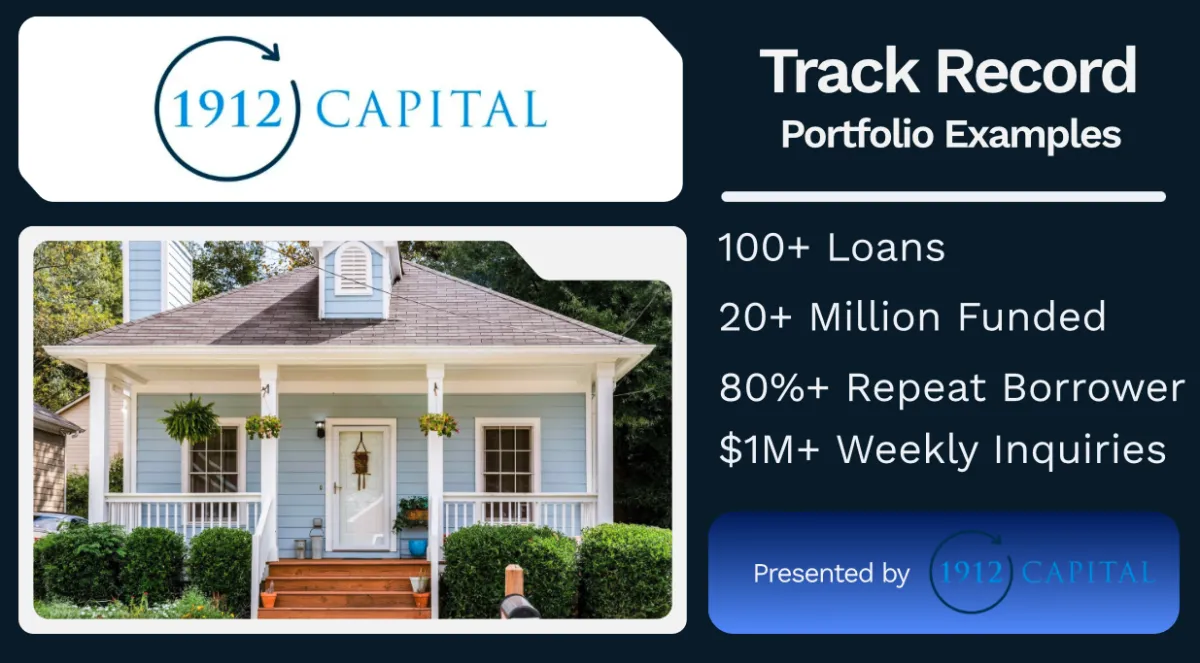
$20M+ deployed | 150+ loans funded | ~2% default rate | 0 Investor losses
Example Deal
Fix & Flip Investor Purchase: $140K | Rehab: $40K | ARV: $275K | 1912 Loan: $150K | Exit via sale/refinance ~6 months
Click for Track Record
Click for Fund II Deck
Frequently Asked Questions
We understand we can’t cover every question here—please feel free to reach out if you have any additional questions.
You can email [email protected] or text 623-305-2544
Question 1:What is the major difference between Private Credit and a Multifamily deal?
The primary difference is that private credit focuses on lending, while multifamily deals focus on property ownership.
With private credit, investors act as lenders, earning fixed, predictable income backed by real estate collateral, typically with shorter durations (around 6–9 months). 1912 Investors are participating in a diversified portfolio of loans, rather than a single asset, which can help reduce concentration risk. The focus is on capital preservation and consistent cash flow.
With multifamily investing, investors are equity owners in a property, or they may invest through a fund or REIT. Returns are tied to property performance, market appreciation, and eventual sale, often over a longer time horizon (3–7+ years), with less predictable cash flow.
In short:
Private Credit: Debt investment, asset-backed, short-term, income-focused
Multifamily: Equity investment, market-driven, long-term, appreciation-focused
Both can play a role in a portfolio, but they serve different objectives depending on an investor’s goals.
Question 2: Are the returns fixed or projected?
The returns presented are fixed returns by investment class, but they are not guaranteed. Returns are generated from interest paid by borrowers on short-term, asset-backed loans. While the strategy is designed to prioritize capital preservation, all investments carry risk. To date, 1912 Capital has consistently made all monthly distributions to investors.
Question 3: How are investor returns protected if loans don’t perform?
Investor returns are protected through a combination of conservative underwriting, asset-backed security, and active risk management.
To date, we have completed three foreclosures, all with zero losses to investors. In each case, the properties were quickly resold, often to other borrowers within our network at values equal to or greater than the outstanding loan balance.
We mitigate risk and return through:
-First-position lien on every loan
-Conservative leverage (~65% loan-to-value)
-Short loan durations (target ~6 months)
-Experienced, repeat borrowers
While our standard loan term is six months, extensions are common in this asset class. Our current average loan duration is approximately nine months, reflecting real-world project timelines while still maintaining a short-duration strategy.
Question 4: How has 1912 Capital’s loan portfolio performed to date?
150+ loans funded with a low default rate (~2%) and zero realized investor losses to date. While some loans require extensions or active management, overall performance has remained strong and consistent. 1912 Capital has delivered an average 12% annual interest payout and has never missed a payment.
Question 5: What happens if a borrower cannot repay?
If a borrower is unable to repay, we take a proactive, structured approach:
We first pursue a resolution, typically through a structured extension or modified repayment plan
If necessary, we enforce our first-position lien to take control of the asset
This may ultimately result in foreclosure and an orderly sale of the property
At every stage, our priority is to protect investor capital and maximize recovery.
Question 6: What does the fee structure look like for Fund II?
Fund II is designed to be simple, transparent, and aligned with investors:
- No hidden fees at the investor level
- Returns are quoted net to investors
1912 Capital generates revenue primarily through borrower-paid interest and fees, with average borrower rates around 18%.
Full details are outlined in the Private Placement Memorandum
Question 7: What happens after the 2-year term?
At the end of the 2-year term, investors can choose to withdraw their capital or roll their investment back into the fund, subject to availability. Our goal is to provide a seamless transition so investors can continue earning consistent returns without interruption if they choose to remain invested.
Question 8: Has 1912 Capital had to do any capital calls?
No, 1912 Capital has not issued any capital calls to date. The fund is structured to operate within its committed capital base, and our short-duration loan strategy allows capital to be recycled efficiently without requiring additional contributions from investors.
Our focus on conservative leverage, strong deal selection, and active portfolio management is designed to maintain liquidity and minimize the need for future capital calls.
Question 9: How are investors taxed (1099 vs K-1) in Fund II?
Investors receive a Form 1099, not a K-1.
Because investors participate as lenders rather than equity owners, returns are generally treated as interest income. Interest is typically reported when it is paid or made available to the investor.
This structure simplifies tax reporting compared to K-1 investments, which often involve more complex filings and delays.
1912 Capital recommends that investors consult their tax advisor regarding their specific situation.

Subscribe to Our Monthly Newsletter
Get more investment insights and market updates from 1912 Capital. Stay informed on private credit, real estate trends, and opportunities designed to deliver consistent, risk-managed returns.
1912 Capital


Quick links
Support
Privacy Policy
Terms & Conditions
Contact Details
Borrow: [email protected]
Invest: [email protected]
Borrow: 602-610-1912
Damon Cuzick
Invest: 623-305-2544
Nick Jackson
Copyright 2026. 1912 Capital. All rights reserved.